With #SOCIETY5.0, borders will disappear. Just as I was about to start writing, suddenly John Lennon’s song “IMAGINE,” released in 1971, came to my mind. While trying to gather my thoughts on what to write, I found myself whispering the lyrics of the song. Then I realized that in 1971, he described #SOCIETY5.0. Even though it hasn’t been mentioned yet, he explained it so beautifully and subtly!
Imagine there is no heaven
It’s easy if you try
No hell below us
…
You may say I am a dreamer
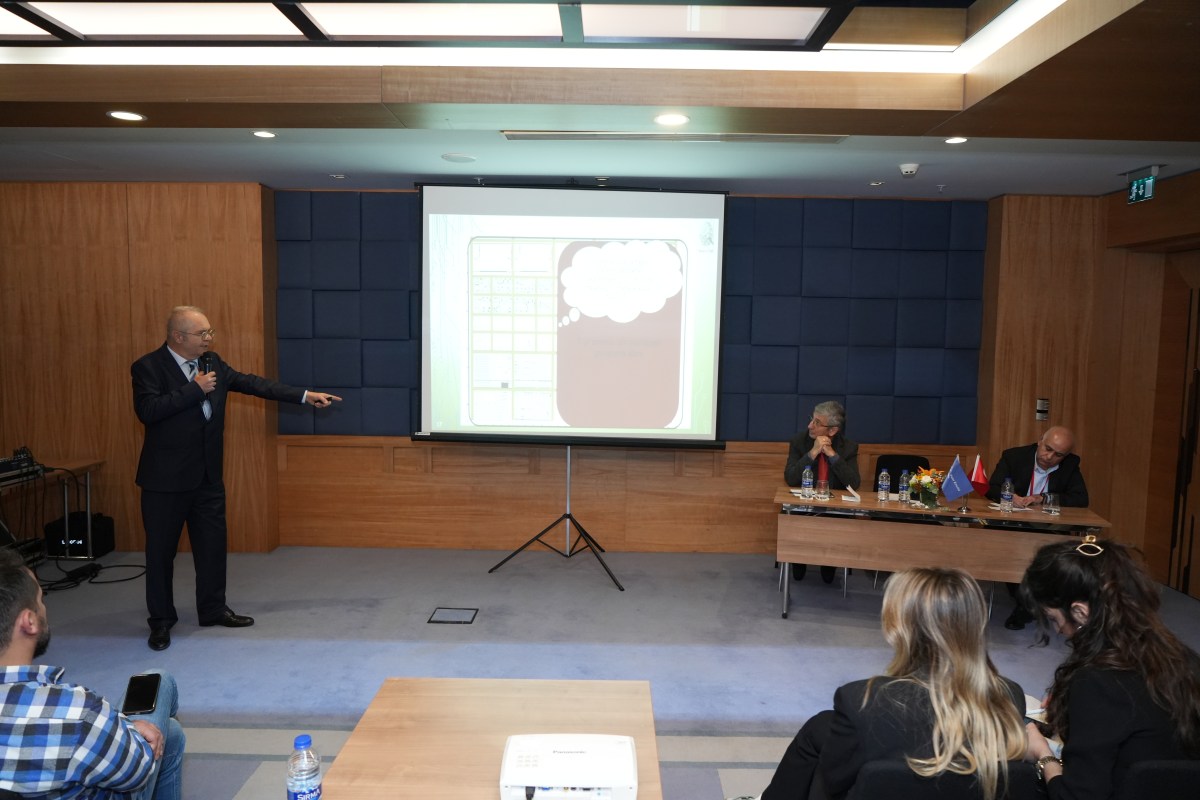
You may say I am a dreamer! Because I have a big dream. I want to prepare for the future, the near future, with you all before anyone else. When preparing for Society 5.0, the most important thing is that we will seek the support of science above all else. Did you know that there is a Society and Science Center at the Middle East Technical University? Do you know about the Research Presentation Contest organized in collaboration with the Community and Science Practice and Research Center by the Science Communication Office? Our contest called “Tell Your Research” was held on December 23, 2023, at the Exhibition Area of the Community and Science Center located in the Science Center building.
This work increased my hopes and dreams for the future. You can find these pages on the university’s website. When you search for METU Community and Science Center, it comes up immediately. This center has been operating since 2006. Nevertheless, I cannot help but criticize them; I found their mission and vision insufficient.
If it were up to me, I would write the MISSION: “We set out to ignite scientific curiosity and promote scientific literacy. We aim to involve everyone, from seven to seventy, in interactive and participatory scientific activities. By 2025, we aim to achieve an increase of over 30% in scientific literacy across society. By stimulating interest in scientific discoveries, we commit to connecting at least 1 million individuals of all ages with science. Thus, we aim to impart scientific thinking and research skills to the general public and integrate the power of science into everyone’s daily life.”
And as the VISION: “We commit to increasing scientific awareness through research-based activities conducted through national and international strategic partnerships. By 2030, we aim to reach a broad audience covering at least 15 million individuals and increase the rate of scientific literacy to 40%. Additionally, we aim to increase interest in science and technology by at least 25%, become a center that has contributed to at least 100 significant international scientific publications, and establish at least 10 strategic partnerships internationally. Through these efforts, we aim to make our society a global center for science and innovation.”
For a slogan, I would write at the top: “DISCOVER, LEARN, SET SAIL TO THE FUTURE WITH THE WIND OF SCIENCE.”
The two most important scientific algorithms will prepare us for Society 5.0. You are already familiar with one of them from my writings, the “Tabu Algorithm”; the other is the “Dreamer Algorithm.” Of course, besides these, we should not forget algorithms that will assist us such as ranking, search, and hash-like algorithms. Let’s conclude our writing today by explaining the Dreamer Algorithm.
We will use the Dreamer algorithm, especially to improve the ability of the world around the Society 5.0 model to explore and understand. Here are the key features of the Dreamer algorithm:
Experience Replay: Dreamer uses experience replay methods in the learning process. The model learns by replaying past experiences and using these experiences.
Modeling and Planning: Dreamer includes modeling and planning processes. Modeling involves creating an internal model of the environment. Planning involves predicting future steps using this internal model and planning optimal decisions.
Multi-Objective Learning: Dreamer supports multi-objective learning. This allows the model to learn a range of tasks and transfer between these tasks.
Stochastic Moves and Uncertainty: Dreamer considers environmental uncertainties and stochastic (random) events. This allows the model to cope with uncertainty.
The Dreamer algorithm aims to enable machines to effectively navigate complex and changing environments, particularly in autonomous systems and robotic applications. Such artificial intelligence models typically enhance the ability to learn and explore tasks to accomplish them and understand the environment.
Because the Dreamer algorithm is a complex concept, you can better understand it with examples. Let’s explain it through examples, based on the task of a robot moving around its environment and reaching a specific goal:
Experience Replay:
The robot perceives its surroundings through cameras and sensors.
Past experiences are recorded and stored in a memory unit.
For example, past encounters with obstacles, situations of reaching the goal, and different environmental conditions are examples of these experiences.
Modeling and Planning:
Dreamer creates an internal model using these past experiences. This internal model reflects the dynamics and features of the environment.
In the planning phase, the robot evaluates different action options using the internal model and predicts future steps. For example, it plans a specific route to overcome an obstacle.
Multi-Objective Learning:
The robot learns not only a specific task but also different tasks simultaneously. For example, it can handle both the task of reaching the goal and the task of recognizing specific objects at the same time.
Stochastic Moves and Uncertainty:
Environmental conditions may change and include uncertainty. The Dreamer algorithm takes these uncertainties into account and helps the robot adapt to the variables in its environment.
For example, when the robot encounters an obstacle, it can find a solution by determining its plans for overcoming the obstacle and considering uncertainties.
The Dreamer algorithm allows machines to learn in machine learning and robotic fields, enabling them to perform complex tasks. Here, it will be artificial intelligence that we design for it, not the robot itself.
Tabu search algorithm and Dreamer algorithm are algorithms designed for different types of problems. Both can address specific types of optimization problems. Here’s a brief description and comparison of both algorithms:
Tabu Search Algorithm:
Objective:
The Tabu search algorithm is commonly used to solve combinatorial optimization problems.
It aims to find the best solution by exploring the solution space.
Working Principle:
The algorithm uses a set of rules and restrictions to temporarily reach good solutions.
The tabu list keeps track of temporarily visited solutions and prevents revisiting the same solutions.
Type of Optimization:
Tabu search typically aims to avoid local optima and reach global optima.
Dreamer Algorithm:
Objective:
The Dreamer algorithm is a model designed specifically for autonomous control and online learning problems.
It focuses on machine learning and learning-based control problems.
Working Principle:
It includes processes like experience replay, modeling, and planning.
The model learns from interacting with the environment and uses these experiences to predict future situations.
Type of Optimization:
The Dreamer algorithm adopts an agnostic learning approach and aims to learn various tasks.
Comparison:
Scope:
While Tabu search focuses on combinatorial optimization problems, the Dreamer algorithm focuses on machine learning and learning-based control problems.
Objective:
Tabu search aims to find the best solution, whereas the Dreamer algorithm targets environmental exploration and online learning.
Application Areas:
Tabu search is suitable for combinatorial optimization problems like sorting, placement, and routing problems.
The Dreamer algorithm is used in learning-based tasks in robotics, artificial intelligence, and autonomous systems.
Combining the two algorithms can compensate for each other’s shortcomings or provide a more effective solution when used together. Here are some advantages of combining them in certain cases:
Comprehensive Solution:
Tabu search is typically effective for combinatorial optimization problems, while Dreamer is used for learning-based control problems. By combining these two algorithms, an optimization problem can be addressed from both combinatorial and learning-based perspectives.
Informed Decisions:
The Dreamer algorithm accumulates experience by interacting with the environment. It can predict future situations using these experiences. The Tabu search algorithm, on the other hand, uses a tabu list to follow temporary solutions. Dreamer’s ability to accumulate experience can help the Tabu algorithm find better solutions.
Long-Term Planning:
Dreamer focuses on long-term planning. It can predict future situations and plan based on these predictions. While Tabu’s search progresses through temporary solutions, Dreamer’s long-term planning ability, when combined, can lead to more strategic and long-term solutions.
Coping with Uncertainty:
Dreamer is designed to address environmental uncertainties. If uncertainty is a significant factor in your problem, Dreamer’s ability to handle it, combined with the Tabu search algorithm, can provide better coping strategies.
In the preparations we made for Society 5.0, especially to prevent the occurrence of uncertain problems and to prevent us from getting stuck in the beginning, the Dreamer Algorithm will be very useful.
Looking forward to meeting you in a new #SOCIETY5.0 article. Stay tuned with love.
 okandinc