Today at work during our lunch break, Bilal and I were chatting. One thing led to another, and we found ourselves discussing management systems. The world is changing and developing at such a rapid pace that the only way to cope with the uncertainty it brings is to create a new management system.
Humanity has not yet completed its development; only the processes have accelerated. From hunter-gatherer societies to agricultural societies, industrial societies, and the knowledge society we find ourselves in today, we have progressed. Soon, we will encounter #SOCIETY5.0. Some see it as a smart society, but I believe it will be beyond just intelligence. A single and linear intelligence won’t be enough. We’ll need superhumans. With the transition to an industrial society, the need for management emerged. I will explain these management systems to you one by one.
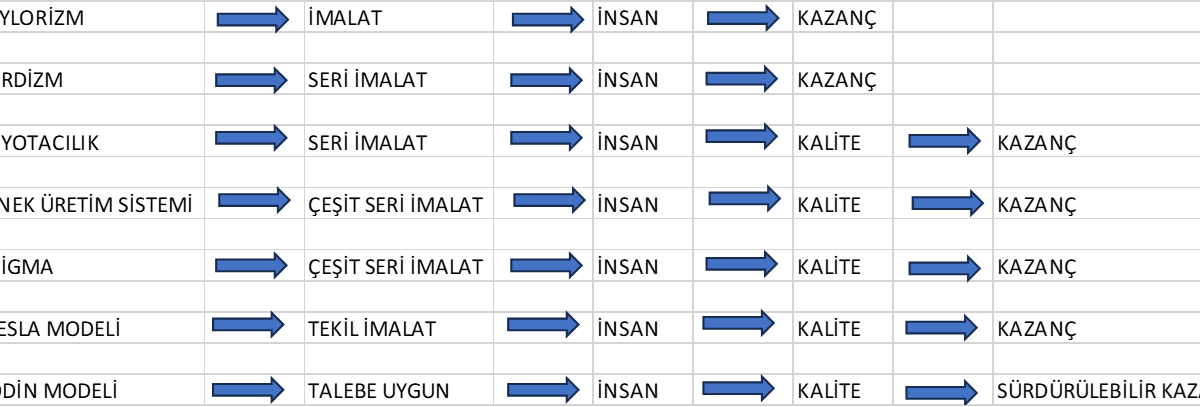
Taylorism, Fordism, Toyotaism, Flexible Manufacturing Systems (FMS), and Six Sigma are the most effective and commonly used field management systems:
Taylorism:
It’s a production model based on scientific management principles.
It focuses on the division of labor and the specialization of workers.
It promotes standardized work processes.
It evaluates worker performance based on measurable and improvable criteria.
Fordism:
It’s an application of Taylorism focusing on production processes.
It encourages high-volume mass production.
It adopts standardized production systems like assembly lines and production lines.
It aims for economically cheap production.
Toyotaism:
It’s associated with the Toyota Production System (TPS).
It’s focused on waste reduction and continuous improvement.
It emphasizes flexibility and efficiency.
It includes concepts like “Just-in-Time” production and “Kaizen.” Flexible Manufacturing Systems (FMS):
It combines automation and flexibility in production processes.
It optimizes production processes using technologies like automatic machines and robots.
It allows quick adaptation to changes in production.
Six Sigma:
It’s a quality management methodology.
It aims to reduce errors and variance in business processes. It uses the DMAIC (Define, Measure, Analyze, Improve, Control) methodology.
It’s based on statistical analysis and data-driven decision making.
While Taylorism and Fordism reflect a more hierarchical and imposed structure on workers, Toyotaism and Flexible Manufacturing Systems encourage worker participation and continuous improvement. Six Sigma provides a specific quality-focused approach and relies more on data analysis. Taylorism and Fordism are generally focused on productivity and low cost. Toyotaism and Flexible Manufacturing Systems focus on both productivity and quality. Six Sigma, on the other hand, focuses on quality and process improvement. Taylorism and Fordism are commonly used in mass production industries, while Toyotaism and Flexible Manufacturing Systems are more prevalent in the automotive and other manufacturing sectors. Six Sigma can be used for quality management in many industries.
Each production system has its weaknesses. Here are some of the fundamental flaws of these systems:
Taylorism and Fordism:
Neglect of the human element: These systems tend to see workers merely as production factors, neglecting human emotions, motivation, and creativity.
Monotony and loss of motivation: Standardization of jobs and the intensity of repetitive tasks can lead to loss of motivation and monotony among workers.
Lack of flexibility: Production lines in these systems are often fixed and resistant to change, making it difficult to quickly adapt to the market.
Toyotaism and Flexible Manufacturing Systems (FMS):
Dependency on high technology: Automation and complex production systems depend on high technology and require constant maintenance. Technological failures or maintenance requirements can adversely affect production continuity.
Decrease in worker skills: With increasing automation, the need for certain skill levels of workers may decrease, leading to unemployment for workers with specific skills in the labor market.
Investment costs: Flexible manufacturing systems like FMS require complex machines, software, and processes, which can result in high investment costs for installation and maintenance.
Six Sigma:
Overemphasis on data: Six Sigma focuses on data-driven decision-making, and sometimes this can overlook the complexity of the real world. Limited or missing data sets used in real-world applications can lead to problems.
Slow implementation process: The complexity and long processes of the DMAIC methodology can make it difficult to adapt to innovative or rapidly changing markets.
Neglect of the human factor: Six Sigma often focuses on data and processes and trivializes the human factor. However, the importance of employee participation and motivation in process success should not be underestimated.
Fayol and Weber’s management theories have had a significant influence on the development of modern industrial production systems and the shaping of management understandings. These theories aim to think deeply about business management, organizational structure, and processes, and to base management on a scientific foundation. Here’s how these theories have impacted modern production systems:
Fayol’s Principles of Management: Functional Management: Fayol defines management as five functional areas: planning, organizing, commanding, coordinating, and controlling. These functions play a fundamental role in shaping the management processes and organizational structures of modern production systems. Authority and Responsibility: Fayol advocates for the determination of authority and responsibility. This leads to the formation of hierarchical structures and the establishment of a functional organization. Discipline and Unity: Fayol emphasizes the importance of discipline and unity in the workplace. This ensures that production processes are conducted in an orderly and coordinated manner. Flexibility and Improvement: Fayol’s “Flexibility Principle” encourages flexibility in modern production systems. Continuous improvement and adaptation are fundamental features of modern production systems and may reflect Fayol’s management principles. Weber’s Bureaucratic Management Theory: Rationality and Hierarchy: Weber’s bureaucratic management theory emphasizes rationality and hierarchical structure in businesses. This supports the complex structures of modern production systems and defines clear roles. Formalization and Standardization: Bureaucratic structures rely on formalization and standardization. This ensures that production processes are conducted according to defined procedures and standards, which is important in systems like Taylorism and Fordism. Authority and Control: Bureaucratic systems support a centralized determination of authority and control. This provides an effective framework for managing and supervising production processes. Specialization and Division of Labor: Bureaucratic structures promote division of labor and specialization. This aligns with the principles of job division and specialization in systems like Taylorism and Fordism. Fayol and Weber’s management theories have played a decisive role in modern production systems’ management and the formation of organizational structures. The principles of these theories continue to shape management practices in many industries today.
Survivorship bias often refers to making generalizations and misunderstanding the reasons behind success based on the experiences of those who have succeeded. This bias arises from ignoring those who have failed when analyzing the success of a particular group. However, by considering this bias, the following three golden rules for success in production systems may be valid:
Multiple Scenario Planning: Focus not only on success stories but also on failure stories: Focusing only on success stories may overlook possible problems and mistakes that you might encounter in the real world. Therefore, by examining both success and failure stories, be prepared for various scenarios. Evaluate risks and uncertainties: To reduce the impact of survivorship bias, consider potential risks and uncertainties. Keep your plans flexible to adapt to each scenario and continuously assess risks. Employee Engagement and Feedback: Utilize employees’ experiences and feedback: Listen to your employees’ experiences and perspectives in the workplace. Their viewpoints are highly valuable in improving production processes and identifying potential issues. Learn from both success and failure stories and actively involve your employees in process improvement. Continuous Improvement and Adaptation: Embrace flexibility and continuous improvement: Encourage a culture of flexibility and continuous improvement in your production systems. Be open to change and innovation, and don’t hesitate to revise your strategies based on feedback and experiences. This approach will help you adapt to different scenarios and ensure long-term success. By following these golden rules, you can mitigate the impact of survivorship bias and make more informed decisions for your production systems.
 okandinc