The Brexit referendum held in the United Kingdom in 2016 is considered not only a political decision to separate, but also a significant systemic transformation in the history of modern economics. Much of the research on Brexit has focused on macroeconomic impacts, foreign trade performance, investment trends, and political consequences. In contrast, the examination of Brexit from the perspectives of production systems, value streams, and lean thinking has been relatively limited. The aim of this study is to examine Brexit within the framework of the Toyota Production System, Value Stream Management, and Lean Thinking principles. In this context, the effects of Brexit on production systems are evaluated in terms of flow continuity, cycle time, inventory levels, waiting times, bureaucratic workload, and supply chain performance.
The study reveals that Brexit increased activities that do not directly create added value in production systems, added new bottlenecks to value streams between the European Union and the United Kingdom, and negatively impacted competitiveness, particularly in the automotive, food, and high-tech sectors. In this context, I have viewed Brexit not only as a political separation process, but also as a significant disruption to the flow of global value chains and a problem of systemic efficiency. My message to the European Union at this point would be to review their European Goods decisions from this perspective.
Keywords: Brexit, Lean Manufacturing, Toyota Production System, Value Stream Mapping, Supply Chain, Automotive Industry, Global Value Chains
In the 21st-century economy, countries are not only units that produce goods and services, but also important nodal points in global value flows. Today, competition takes place not only between firms, but increasingly between value chains. Therefore, for modern economies, success is closely related to how seamlessly resources, components, products, information, and labor can move across borders.
In this context, Brexit is not only a political decision to separate, but also a restructuring of one of the world’s most complex transnational value flows. Much of the research on Brexit has focused on macroeconomic effects, trade performance, investment trends, and political consequences. In contrast, the evaluation of Brexit from the perspective of production systems, supply chains, and lean thinking has remained relatively limited. It has been influential in the exit of firms like HONDA from the UK.
In this study, I examined Brexit within the framework of the Toyota Production System, Value Stream Management, and Lean Thinking principles. The main argument of the study is that Brexit, when evaluated independently of its political consequences, is one of the most significant value flow disruptions in modern economic history. In this respect, Brexit should be considered not only as a process of separation between states, but also as a systemic transformation that directly impacts production, logistics, supply, and information flows. From a political standpoint, Brexit has been debated through concepts such as national sovereignty, immigration policies, border control, and regulatory independence. However, a different picture emerges when viewed from the perspective of production systems. For a production system, a border is not merely a line drawn on a map. A border can mean a delay in a part, a truck waiting, a factory increasing its safety stock, or a postponement of an investment decision. From a lean thinking perspective, the success of a system is measured more by how uninterrupted the flow is, rather than by political rhetoric. One of the fundamental assumptions of the Toyota Production System is that when the flow is disrupted, costs increase, quality performance weakens, and competitiveness decreases. Therefore, it is possible to evaluate Brexit not only as a political event, but also as a large-scale intervention in the flow of value for European production systems. In this study, I analyzed the effects of Brexit on production systems through lean thinking concepts such as waiting, overprocessing, excess inventory, cycle time, supply chain fragility, and bureaucratic burden. Thus, it is demonstrated that Brexit is not merely a change in trade regulations for global value chains, but also a structural system problem affecting the continuity of flow.
2. Theoretical Framework
2.1. Lean Thinking and the Concept of Value
The main goal of lean thinking is to make processes more efficient, faster, and sustainable by systematically eliminating activities that do not create value for the customer. According to Womack and Jones, the lean approach is based on defining value from the customer’s perspective and delivering this value to the customer with the least use of resources.
Lean thinking is based on five fundamental principles: defining value, identifying the value stream, ensuring the flow, establishing a pull system, and aiming for excellence. These principles allow for the separation of value-creating and non-value-creating activities in production and service processes.
At the heart of this approach is the concept of value stream. The value stream encompasses all activities a product or service goes through until it reaches the customer. While some of these activities directly create value, others are only carried out to keep the processes going and do not produce any additional benefit for the customer.
Before Brexit, the European Union had created a highly integrated value stream structure thanks to common standards, free movement, and the largely eliminated customs controls. Within this structure, production networks have enabled suppliers, manufacturers, and customers located in different countries to work in a coordinated manner. From a lean thinking perspective, this integrated structure within Europe resembles the application of the seamless flow principle on an international scale. After Brexit, however, new administrative, logistical, and regulatory obstacles were added to this flow; the continuity of the value stream weakened.
2.2. Toyota Production System and the Concept of Waste
The Toyota Production System, as one of the most important application areas of lean thinking, is based on reducing waste in production processes. At this point, I must mention that production, supply, office, and engineering processes are a whole. In this system, waste is defined as all activities that do not create value for the customer but consume resources. Traditionally, seven basic types of waste stand out in the Toyota Production System: overproduction, waiting, transportation, excessive processing, excessive inventory, unnecessary movement, and errors.
Many practices that emerged after Brexit have led to the reproduction of these types of waste in different forms. In particular, customs documents, rules of origin, veterinary controls, border crossing procedures, and certification processes are activities that do not directly increase the value of the product from the perspective of the end customer. Nevertheless, these activities require time, labor, financing, and management capacity from businesses. This creates a significant contradiction from a lean thinking perspective. Because while lean systems aim to eliminate unnecessary steps from processes and simplify the flow, the new regulations that emerged after Brexit have added additional steps to production and trade processes. As a result, the lean level of production systems has decreased, and the weight of non-value-adding activities in the total process has increased.
2.3. Brexit and Little’s Law Perspective
One of the fundamental approaches used to explain process performance in lean systems is Little’s Law. Little’s Law shows the relationship between cycle time, the amount of work in the system, and the output rate. This relationship can be expressed as follows:
Lead Time = Work in Process / Throughput
According to this formula, when the amount of work in the system increases or the output rate decreases, the cycle time increases. Similarly, increased waiting times in processes require holding more intermediate or safety stock to maintain the same output level.
Border controls, customs procedures, document verification processes, and regulatory differentiations that emerged after Brexit have increased cycle times in value flows between the European Union and the United Kingdom. From a Little’s Law perspective, this situation leads businesses to hold higher safety stocks to manage uncertainties. Higher stock levels not only increase warehouse costs but also increase the amount of tied-up capital in the system. Therefore, Brexit can be considered not merely a trade policy change or border adjustment but a structural intervention at the system level that increases cycle time. The slowdown in flow weakens low inventory and rapid response capabilities, which are among the fundamental goals of lean systems.
2.4. The Concept of Sovereignty-Related Waste
In the Toyota Production System, waste is considered as activities that do not create value for the customer but consume resources. In this study, the concept of “Sovereignty-Related Waste” is proposed based on this approach.
Sovereignty-related waste refers to the losses of time, cost, labor, and resources caused by activities created in line with political, legal, or administrative independence goals, but which do not directly create value for the customer. This concept can be used to analyze the operational consequences of political decisions on value streams, especially in international trade and production systems.
In the context of Brexit, customs declarations, origin verification processes, repeated certification activities, border controls, and additional document obligations are examples of such waste. These activities do not directly increase the function, quality, or perceived value of the product for the customer. In contrast, for businesses, this means additional costs, longer cycle times, higher inventory requirements, and more complex supply chain management. In this context, Brexit can be considered a large-scale and current example of sovereignty-related waste. While political goals such as regulatory independence or border control are emphasized, in terms of production systems, the same process creates new waiting times, extra processing steps, and flow interruptions. Therefore, Brexit is a significant case study that makes visible the tension between sovereignty and value stream efficiency.
3. Pre-Brexit European Value Chains
Before Brexit, the European production system had a highly integrated value chain structure. The free movement of goods, services, capital, and labor within the European Union allowed for the division of production processes between different countries and for these processes to function as parts of a single system.
One of the most prominent examples of this integrated structure is the automotive sector. The automotive industry has a complex production network consisting of numerous suppliers, sub-suppliers, logistics providers, and assembly plants. The parts used in the production of a car can move between different countries multiple times before reaching the final assembly stage. For example, the engine can be produced in Germany, the electronic systems in Poland, the interior trim parts in Spain, while the final assembly can be carried out in the UK.
The efficient operation of this system depended on border crossings being fast, predictable, and low-cost. The European internal market, where there were no customs controls, common standards applied, and logistics flows proceeded uninterrupted, ensured that production networks operated with a high degree of coordination. From a lean manufacturing perspective, this structure can be considered the international application of the “seamless flow” principle. The ability of parts, information, and labor to move across borders without delay was critical for operating with low inventory levels and implementing just-in-time production practices. However, after Brexit, borders have reappeared, adding new points of disruption to value flows, such as customs procedures, document checks, origin verifications, and regulatory differences.
4. New Waste Arising After Brexit
Following Brexit, production and trade relations between the European Union and the United Kingdom have faced new administrative, logistical, and regulatory processes. When evaluated from a lean thinking perspective, these processes have created new areas of waste that do not directly create value for the customer but result in time, cost, and resource consumption for businesses. This section addresses the main types of waste that have emerged after Brexit under the headings of waiting, excessive processing, excess inventory, and unused human potential.
4.1. Waiting Waste
One of the most visible effects of Brexit on production systems is the increase in waiting times. Border crossings, which were fast and predictable within the European Union internal market before Brexit, have become more complex after Brexit due to document checks, customs declarations, origin verifications, and compliance processes. From a lean thinking perspective, waiting is one of the fundamental types of waste that does not directly create value. A truck waiting at the border means not only a logistical delay but also idle capital, unused transport capacity, and disrupted production planning. Similarly, a delayed part can lead to a production line shutdown, extended delivery times, and decreased customer satisfaction.
Therefore, post-Brexit waiting times should be considered not only as delays in commercial transactions but also as a structural waste element that disrupts the flow continuity of production systems. As waiting increases, cycle time lengthens, uncertainty rises, and businesses need to hold more safety stock.
4.2. Excessive Process Waste
The bureaucratic burdens that have emerged after Brexit have added new process steps to production and trade processes. Customs declarations, certificates of origin, certificates of conformity, veterinary controls, and additional reporting obligations can be considered within this scope.
The common feature of these activities is that they do not directly increase the value of the product from the perspective of the end customer. A food producer preparing more documents does not improve the quality or taste of the product; an automotive supplier conducting an additional certification process does not directly improve the technical performance of the part. On the contrary, these processes create additional time, labor, consulting, software, and management costs for businesses. From a lean perspective, too many processes mean that the process becomes unnecessarily complex and that activities not requested by the customer are added to the system. Post-Brexit regulations have made these types of process burdens more visible, especially for small and medium-sized enterprises (SMEs). While large businesses can establish separate units to manage these processes, for small businesses, the same burdens can create proportionally higher costs.
4.3. Excess Inventory Waste
In periods of increased uncertainty, businesses often tend to increase safety stocks. While this behavior is understandable in terms of reducing supply chain risks, excess inventory is a significant type of waste from a lean manufacturing perspective. This is because inventory ties up capital, increases storage costs, makes quality problems invisible, and covers up disruptions in processes.
Following Brexit, due to uncertainties at border crossings, delays in customs procedures, and regulatory changes, many businesses have turned to operating with higher inventory levels to reduce supply risks. Some businesses have created additional warehouse capacity, some have increased safety stocks, and some have tried to develop alternative supply sources.
One of the fundamental aims of the Toyota Production System is to keep inventories at the lowest possible level to make problems visible. In this respect, Brexit has had the opposite effect on the lean manufacturing goals of reducing inventory in many sectors. As uncertainty in the flow increased, businesses tried to protect themselves with inventory; this increased the tied capital and total cost in the system.
4.4. Waste of Unused Human Potential
In lean thinking literature, in addition to the traditional seven types of waste, an eighth type of waste has gradually begun to be discussed: unused human potential. This type of waste refers to the situation where the knowledge, skills, experience, and creativity of employees are not sufficiently utilized.
The decrease in labor mobility between the European Union and the United Kingdom after Brexit has had significant consequences, especially in engineering, advanced technology, research and development, and specialized fields. Production systems are not only composed of machines, raw materials, and physical products. Knowledge, experience, technical expertise, and problem-solving capacity are also integral parts of the value stream.
Therefore, the effects of Brexit are not limited only to the flow of goods and parts. Restrictions on labor mobility and the shrinking talent pool can also weaken the flow of knowledge and the capacity for organizational learning. From a lean thinking perspective, this means that human potential is not fully utilized and the capacity to create value is reduced. In this context, Brexit can be considered a process that creates disruptions not only in physical supply chains but also in the flow of knowledge and skills. The free movement of human capital, particularly in terms of innovation, product development, and advanced manufacturing technologies, remains a critical element for the competitiveness of value chains.
5. Automotive Sector: Brexit’s Most Visible Laboratory
The automotive industry is one of the sectors where the effects of Brexit on production systems can be observed most clearly. This is primarily because automotive production relies on highly internationalized, multi-layered, and time-sensitive supply chains. Producing a vehicle requires the simultaneous coordination of numerous suppliers, sub-suppliers, logistics providers, engineering units, and assembly plants.
Before Brexit, the UK automotive industry was strongly integrated with European production networks. A significant portion of vehicles produced in the UK were exported to the European market, and a considerable portion of the parts used in production were sourced from European Union countries. This structure was based on operating with low inventory levels, just-in-time delivery, and uninterrupted cross-border parts flow.
After Brexit, this integrated structure faced new uncertainties. Customs procedures, rules of origin, border controls, documentation requirements, and the possibility of regulatory differentiation increased supply chain costs in the automotive sector, made logistics processes more complex, and put pressure on investment decisions. Especially for automotive factories operating on a just-in-time production model, even small delays can lead to significant disruptions in production plans. In this context, the Nissan Sunderland plant serves as a symbolic example for evaluating the impact of Brexit on the automotive sector. This plant, considered a vital part of the European production network for many years, faced uncertainties after Brexit in terms of supply chain continuity, export conditions, and investment decisions. For such plants, competitiveness depends not only on production capacity but also on the uninterrupted movement of parts, information, and final products. From a lean perspective, the fundamental problem in the automotive sector is not the ability to produce cars. The real problem is maintaining the uninterrupted flow of value during car production. Because in the automotive industry, disruptions to the flow lead to increased waiting times, higher safety stocks, increased logistics costs, and weakened delivery performance. Therefore, the automotive sector serves as a suitable laboratory for analyzing the effects of Brexit on lean manufacturing systems. The sector’s high level of integration, its reliance on just-in-time production, and its sensitivity to cross-border parts movement have made new types of waste emerging after Brexit more visible. In this respect, Brexit can be considered not only a development that changed commercial conditions in the automotive industry but also a structural intervention that directly affects the continuity of value streams.
6. Brexit and the FMEA Perspective
If Brexit were designed as an engineering project, potential failure modes such as border controls, supply chain disruptions, document processes, labor mobility, and investment uncertainty would need to be assessed within a comprehensive Failure Modes and Effects Analysis framework before implementation. Table 1. Potential Failure Modes Arising from Brexit
Table 1. Potential Failure Modes Arising from Brexit
| Failure Type | Severity (S) | Probabilty (O) | Detection (D) | RPN |
| Customs Delay | 8 | 8 | 4 | 256 |
| Documentation error | 7 | 7 | 5 | 245 |
| Regulatory Divergence | 9 | 6 | 5 | 270 |
| Reduced Labor Mobility | 8 | 6 | 6 | 288 |
| Supply Chain Disruption | 10 | 5 | 5 | 250 |
| Investment Uncertainity | 9 | 7 | 4 | 252 |
A significant portion of the risks foreseen in the Brexit process have materialized over time and have had negative impacts on the performance of production systems. Small and medium-sized enterprises (SMEs) have been particularly affected by this process compared to large-scale firms. The main reason for this is that small businesses have more limited financial and managerial capacity to cope with customs procedures, documentation requirements, logistical delays, and regulatory compliance costs. Many small exporters trading with the European Union have reduced their volume of operations due to increased transaction costs and uncertainties, while some have turned to alternative markets.
7. Brexit from a Value Stream Mapping Perspective
One of the most suitable tools that can be used to assess the effects of Brexit on production systems is the Value Stream Mapping approach. Value Stream Mapping makes visible all the stages a product or service goes through until it reaches the customer, enabling the separation of value-creating and non-value-creating activities.
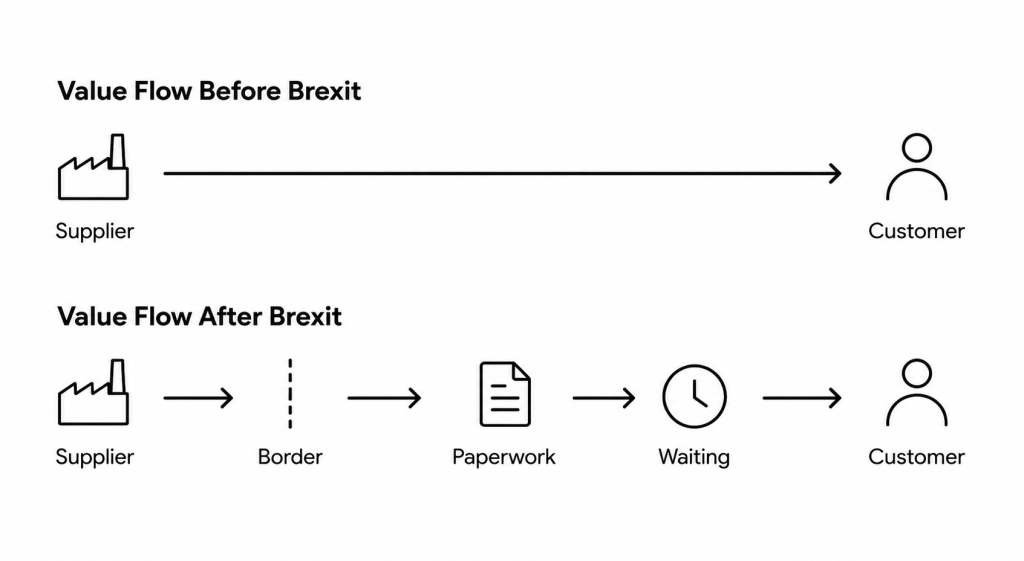
Before Brexit, the value flow between the European Union and the United Kingdom had a simpler and more seamless structure. This process can be simply expressed as follows:
Supplier → Producer → Customer
In this structure, the relationship between the supplier, producer, and customer progresses relatively directly; border crossings, customs procedures, and additional document checks do not create a significant interruption in the value flow.
After Brexit, new administrative and regulatory stages have been added to the same value flow. The process has become more complex as follows:
Supplier → Customs → Inspection → Certification → Origin Verification → Producer → Export Control → Customer
This comparison clearly shows the fundamental problem that Brexit has added to the value flow. The number of value-creating activities has not changed significantly; The product still travels from supplier to manufacturer, and then to customer. However, new steps have been added to this flow that do not directly create value for the customer.
This is where the fundamental question of lean thinking becomes important: Which of these activities creates value for the customer? Customs declaration, origin verification, preparation of additional documents, or border control do not directly increase the function, quality, or perceived value of the product. On the contrary, these activities require time, cost, labor, and management capacity for businesses.
Therefore, the new value stream that emerged after Brexit has transformed into a longer, more complex, and more wasteful structure from a lean thinking perspective. Each new control and documentation process added to the flow increases cycle time; it increases waiting times, extra processing, and inventory needs. Thus, Brexit has brought about a complication of the value stream, not a simplification.
From a Value Stream Mapping perspective, the main impact of Brexit is the addition of new non-value-adding activities to production systems. This situation has changed not only the legal status but also the operational efficiency of trade between the European Union and the United Kingdom. Therefore, Brexit, when viewed from a simple perspective, can be seen not merely as a political separation process but as a systemic intervention that adds new bottlenecks to the flow of values. None of the above.
| Indicator | Before Brexit | After Brexit |
| Custom Clearance | none | Yes |
| Origin Verification | None | Yes |
| Certification Burden | Low | Higher |
| Safety Stocks | Low | Higher |
| Cycle Times | Shorter | Longer |
| Risk of Flow Interruption | Lower | Higher |
Discussions on Brexit are mostly conducted along political, legal, and ideological axes. However, from the perspective of production systems, the effects of Brexit are revealed more through value flows, cycle times, cost structure, and supply chain performance than through political rhetoric. This is because production systems respond not to ideological preferences, but to operational variables such as time, cost, quality, flexibility, and flow continuity. Therefore, a production systems perspective is needed to understand the real effects of Brexit. A factory’s assembly line is more concerned with whether the parts arrive on time than with the justification for political decisions. A supply chain operates not with slogans, but with delivery times, inventory levels, logistics costs, and regulatory compliance processes. In this respect, Brexit should be evaluated not only within the context of political sovereignty debates, but also in the context of production systems and value chains. Recent studies show that Brexit has had negative effects on the UK’s export performance, investment trends, and position within European value chains. The decline in exports to the European Union, the withdrawal of small exporters from the market, the increase in supply chain costs, and the decrease in investment appetite can be considered concrete indicators of this transformation. These developments show that Brexit has changed not only the volume of trade but also the operational structure of trade. From a lean thinking perspective, the fundamental result of this transformation is the addition of new activities that do not create added value to the value stream. Customs declarations, origin verification processes, certification obligations, border controls, and additional document processing do not directly increase the value of the product for the customer. On the contrary, these activities require time, cost, and management capacity for businesses. Therefore, the structure that emerged after Brexit contradicts the simple, fast, and seamless flow concept targeted by lean systems.
The Trade-off Between Sovereignty and Flow
One of the fundamental issues revealed by Brexit is the trade-off between sovereignty and operational efficiency. A country may gain a higher level of regulatory independence, border control, and regulatory flexibility. However, this independence can create additional coordination costs, longer cycle times, and more complex supply processes within international value chains. This situation highlights the tension between political choices and the needs of production systems. A choice seen as a gain in political sovereignty may translate into waiting, overprocessing, excess inventory, and uncertainty for production systems. Therefore, Brexit serves as a significant case study for examining the relationship between national sovereignty and the efficiency of value flows. In this context, the fundamental lesson of Brexit is that global value chains are sustained not only by legal agreements but also by operational continuity. The more uninterrupted, predictable, and cost-effective the flow in a value chain, the more competitive the system becomes. Conversely, each new control point, document, and waiting area added to the flow reduces the system’s leanness and weakens its competitiveness..
9. Conclusion and Recommendations
This study has shown that Brexit should be considered not only as a political or commercial transformation, but also as a systemic intervention affecting global value flows. From a lean thinking perspective, Brexit has added new waiting points, additional processing steps, and regulatory uncertainties to production and trade processes between the European Union and the United Kingdom.
According to the study’s key findings, Brexit has increased waiting times, extended cycle times, increased inventory levels, multiplied bureaucratic burdens, and slowed down the flow of information and expertise. These effects contradict the fundamental goals of lean manufacturing systems: uninterrupted flow, low inventory, rapid response, and the reduction of non-value-creating activities for the customer.
This study also offers a conceptual contribution to the lean thinking literature by proposing the concept of “Sovereignty-Related Waste.” Sovereignty-related waste refers to the time, cost, and resource losses caused by activities created in pursuit of political, legal, or administrative independence goals, but which do not directly create value for the customer. The Brexit example demonstrates that some activities resulting from political and administrative choices can increase system costs without creating value for the customer. The fundamental principle of the Toyota Production System is that any activity that does not create value for the customer should be questioned. The Brexit experience shows that this principle applies not only to in-factory production processes but also to economic integration systems, international trade networks, and global value chains. When flow is disrupted, costs increase, and when costs increase, competitiveness weakens. Therefore, the key recommendation for decision-makers is to evaluate political and commercial regulations not only in terms of their legal or diplomatic consequences but also their operational impact on value flows. When designing new border regulations, trade agreements, or legislative changes, waiting times, inventory requirements, documentation burden, supply chain fragility, and compliance costs for businesses should be considered. For businesses, it is important to create more resilient value chains against structural changes like Brexit. In this context, supplier diversification, digital customs processes, risk-based inventory management, alternative logistics channels, and information systems that increase supply chain visibility stand out. However, these measures must be balanced with the fundamental principles of lean thinking, as excessive inventory or excessive supplier diversification can also create new costs and complexities. Future studies could examine Brexit-like decoupling processes in more detail from a value stream engineering perspective. Regional trade blocs, strategic protectionist practices, technological divergences, and geopolitical tensions have the potential to create similar disruptions in global value chains. Therefore, the lean thinking approach offers a useful framework not only for analyzing internal business processes but also for analyzing international economic relations and global production networks.
Source
Bailey, D., & Rajic, I. (2025). Brexit, UK Manufacturing and Industrial Strategy.
Bailey, D., De Propris, L. (2017). What Does Brexit Mean for UK Automotive and Industrial Policy?
Womack, J. P., & Jones, D. T. (2003). Lean Thinking. Free Press.
Liker, J. K. (2004). The Toyota Way. McGraw-Hill.
Ohno, T. (1988). Toyota Production System. Productivity Press.
Christopher, M. (2016). Logistics & Supply Chain Management. Pearson.
Menon, A. (2025). The Economic Consequences of Brexit.
UK Trade Policy Observatory (2025). Which Manufacturing Sectors Are Most Vulnerable to Brexit?
Springford, J., & Spisak, A. (2026). Centre for European Reform Brexit Impact Study.
Make UK (2026). Industrial Supply Chain Resilience Report.


Bir Cevap Yazın